


Atul Adhyapika
improving the quality of primary education
project initiated in 2017
15,554 children | 150 schools | 76 adhyapikas | 32 anganwadis | 20 Anuja Adhyapikas
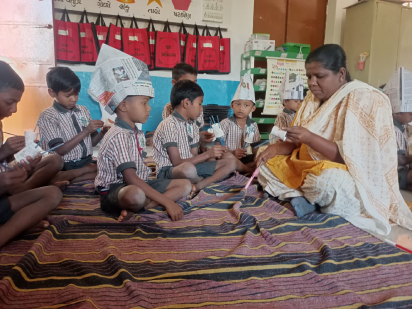
In remote tribal regions, access to quality primary education continues to be shaped by gaps in infrastructure, teacher availability and language barriers. Addressing these challenges, the Atul Adhyapika project works to strengthen the learning environment by enabling local women to take on the role of educators within their own communities. Carefully selected and trained over six months, these women take on the roles of adhyapikas. Driven by a strong sense of commitment, they transform classrooms into spaces that are not only interactive but also joyful.
Their shared cultural and linguistic background with students allows them to respond to individual learning needs with sensitivity, while fostering a nurturing space built on care and understanding. In areas where student–teacher ratios remain inconsistent due to a shortage of trained staff, and where multiple dialects often complicate communication, adhyapikas act as a vital bridge. Their familiarity with local contexts helps them interpret student behaviour, engage with parents more effectively and support the development of each child in a personalised and meaningful way.
Being based within the village, they remain closely connected to families and the wider community, allowing for continued support beyond the classroom.
2025-26 highlights
- conducted mathematics and science activities in 53 schools
- improved reading, writing and numeracy levels for 20% of students, increasing performance from 50% to 70%
- imparted value education to 7,682 students in 77 schools
- facilitated mobile addiction awareness workshops in 77 schools
- enabled a threefold increase in student attendance at anganwadis
Education above all
‘The strength of the school was just 16 when I joined as an adhyapika three years ago. Parents were hesitant to send their children in the village primary schools as they doubted their quality of teaching and upbringing. Instead, they sent their children to schools that were far from their homes. After persistent efforts I have been able to convince the parents that education is beyond our social divide and today the strength of the school has increased to 58 students,’ shares Rina Vank, an adhyapika placed in Bhensdara village.